The morning after a fall, I used to do the same two things every time. I promised God it would never happen again, and I put the whole thing out of my mind as fast as I could.
Both of those felt like repentance. Neither one was.
The promise felt like repentance because it was loud and sincere and it hurt to make. Forgetting felt like repentance because it looked like moving on. But a vow made in the middle of self-disgust has a shelf life of about four days, and the forgetting guaranteed that the next time I fell, I would fall exactly the same way, for exactly the same reasons, and be just as surprised.
There's a better move, and I got it from Dr. Douglas Weiss. In 101 Freedom Exercises he has a short exercise called "Relapse and Research." The idea is simple enough to sound like nothing: if you relapse, study it. Turn the fall into information. Ask what actually happened, write it down, and give it to somebody who will read it back to you.
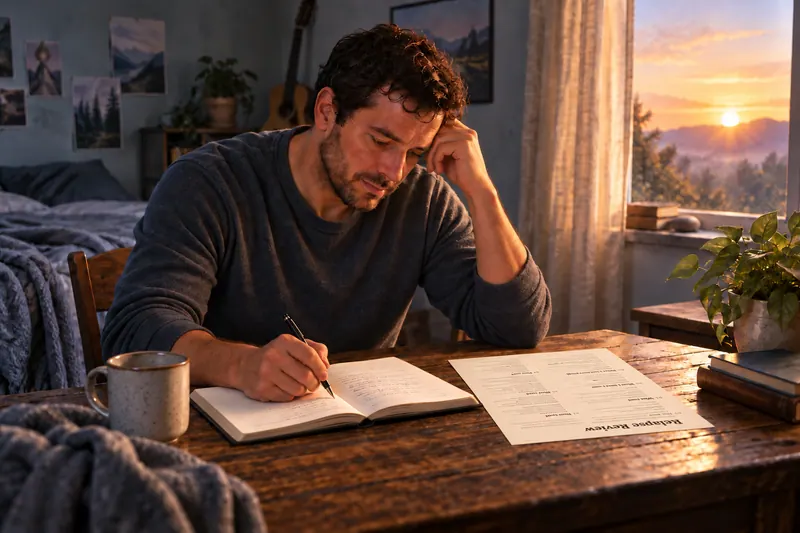
I've been working through a longer version of that exercise, and I put it on a single page you can fold into the front of your journal. Nine sections, no blanks to fill in. You do the writing where you already write.
Download the Relapse Review (PDF) →
Shame is not repentance
This is the part I had backwards for years.
When I fell, the voice in my head did not say "you did something wrong." It said "you are something wrong." And I let that voice talk, because it felt like I was taking sin seriously. Beating myself up felt like the price of admission back to God.
But the two statements do completely different work. I did this leaves a man standing, facing the thing, able to change it. I am this takes him off his feet. And a man on the floor reaches for the thing that makes him stop feeling. Which is the same thing he just fell to.
So the first rule of a review is that you write about what you did, not about what you are. Not because the sin is small. Because the accounting has to be honest on both ends, and "I'm worthless" is not an honest account of a man God sent His Son for.
The first hours after a fall need something simpler than a worksheet. I wrote about those separately in First Steps When You've Fallen and Want to Come Back. This is what comes after.
It was never one decision
The second thing the review does is walk the whole chain.
I used to tell the story of a fall as a single moment. One click. One weak minute. But when I sit down and go backwards step by step — what was the decision before that, and before that, and before that — the picture is never one moment. It's eight or ten small choices, and almost none of them looked like anything at the time.
Staying up an hour after everyone went to bed. Charging the phone in the wrong room. Taking a different route home. Saying yes to one more job in a week that was already full. Skipping the call with my accountability partner because it had been a good week and there was nothing to report.
Nothing on that list is a sin. Every one of them was a step. And the useful thing about steps is that they're much easier to change than the moment at the end, because you're still a whole person when you're standing on them.
Keep walking backwards until you hit a decision that felt completely ordinary. That's usually where the actual work is.
Ask what it was doing for you
This one is harder to write down than it sounds.
A behavior that keeps coming back is doing a job. It's paying you something. Escape, comfort, revenge, a few minutes of feeling like you matter, permission to stop feeling anything at all. Until you can name the wage, you're trying to quit a job you never admitted you had.
I wrote a while back that I wasn't looking for porn, I was looking for proof — proof that I was significant, that I counted for something. Naming that changed more for me than any promise I ever made at 6 a.m. Not because naming it fixed it. Because you can bring a named thing to God. A vague thing just sits there.
So ask what it gave you. Then ask what the real thing would have been. Rest. Being known. Being wanted by my wife. Being allowed to be weak in front of another man without losing my standing. Those are things a person can actually go get.
Write down what worked
Most men skip this section, and I think it's the most important one on the page.
Somewhere in that fall, you did something right. Maybe you stopped sooner than last time. Maybe you got up and left the room before you went back. Maybe you noticed the warning sign, overrode it, but noticed it — and a year ago you wouldn't have seen it at all. Maybe you told someone in two hours instead of two weeks.
Write it down. Not to soften the blow. Because the next high-risk moment is coming, and what you bring into it is whatever evidence you have that you can stand up in it. Evidence is built out of records. If the only record you keep is a list of your failures, you're going to walk into the next one with nothing in your hands.
"I'll be more careful" is not a plan
The last section of the sheet is the one that changes anything, and it's the one most likely to be filled out with fog.
A real plan has a trigger, an action, and a name or a number attached to it. Written in one form: if this happens, then I will do that. If it's after eleven and I'm alone downstairs, then I go to bed. If my wife is out of town, then the laptop stays in the kitchen and Gary gets a text at nine. Decide it now, on paper, in daylight, because the moment itself is not a good time to be weighing options.
Then decide what physically changes. What device, what room, what password somebody else holds. And decide what your accountability partner now has permission to ask you about that he didn't have before. Most of us give our friends permission to ask about everything except the one thing.
It doesn't count until somebody hears it
A review nobody reads is a journal entry.
The whole exercise turns on the last line: who you read it to, and when. Not a summary. The actual pages, out loud, to a man who will tell you what he sees in it that you can't. Then put a date thirty days out to read it again yourself, because the thing you learn about your own pattern has a way of going quiet right about the time it gets useful.
And I'd add one more line at the end, even though it isn't on the worksheet as a question.
None of this is the point. Studying a fall is maintenance work, and maintenance work is not a relationship with God. The review keeps you from repeating the same mistake for the eleventh time. It doesn't make you clean, and it isn't what He's after. He's after you. Do the work, bring the pages, and then go back to the only thing that was ever the goal.
Download the Relapse Review (PDF) →
One page. Adapted from Exercise 46, "Relapse and Research," in 101 Freedom Exercises by Dr. Douglas Weiss, and reordered around the sequence used in relapse-prevention work: facts, chain, function, aftermath, plan.